The Fungibility of Fundamentalism
The social ends justify shifting theological means.
Throughout this year, much of my writing and podcasting hasn’t been tied to the cycle of current events. That’s in large part due to the fact that I’m working on my book, underwent a surgery with a longer than expected recovery, and a shift in my day job.
Amidst all this turmoil and change that has happened off-screen in my personal life, I’ve still kept up with larger beats of what’s happening in white American evangelical christianities - and how stories repeat themselves over years and decades, and how intractable fundamentalism seems to be.
It’s usually surprising to outside onlookers (and sometimes to former insiders like myself) just how resilient fundamentalism and the prejudices it inculcates can be. Fundamentalism resists change to a degree that reaches beyond a literal meaning of “conservatism” or moderation. No passage has quite captured that reality quite like this one from Timothy Gloege’s book Guaranteed Pure, when he described the historical consequences of The Fundamentals (from which the term “fundamentalist” is derived):
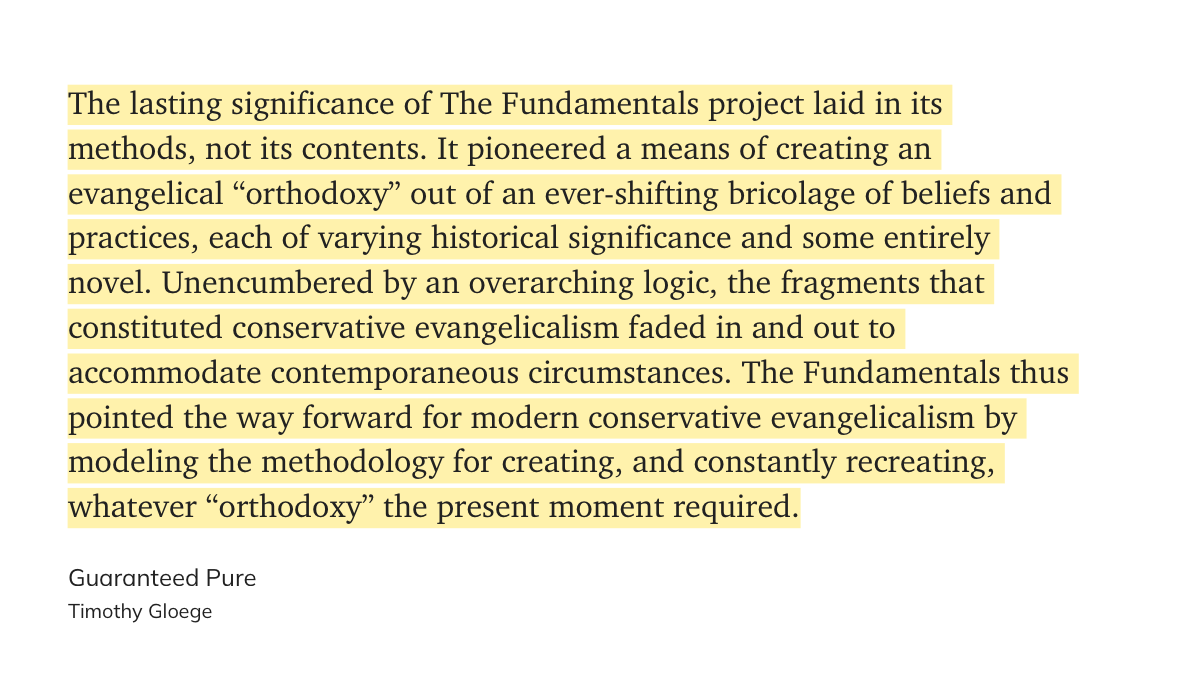
“The lasting significance of The Fundamentals project laid in its methods, not its contents. It pioneered a means of creating an evangelical “orthodoxy” out of an ever-shifting bricolage of beliefs and practices, each of varying historical significance and some entirely novel. Unencumbered by an overarching logic, the fragments that constituted conservative evangelicalism faded in and out to accommodate contemporaneous circumstances. The Fundamentals thus pointed the way forward for modern conservative evangelicalism by modeling the methodology for creating, and constantly recreating, whatever “orthodoxy” the present moment required.”
I keep coming back to this, and how it helps explain the way fundamentalism renews itself. It’s not only through repetition and insistence. It’s how it incorporates new information into its narrative and adapts it, like a recursive loop of confirmation bias.
After listening to and reading so many personal accounts of people who’ve left fundamentalism, I don’t think there’s a single catalyst that’s universal for all people capable of shaking fundamentalist foundations. Still, having some knowledge—even incomplete knowledge—of how fundamentalism works is empowering, and enables us to imagine new futures.